

Commentary
What role does art play in society? What can it teach us, and why is it able to bring strangers together and move us in ways that cannot be achieved by other means? Art prompts reflection. As the language of the heart, it does not so much explain the world as it allows us to live through and experience it.

This is precisely what Krzysztof Gil’s exhibition is like. The artist invites us into the world of his experiences, where exclusion and discrimination are part of everyday life.
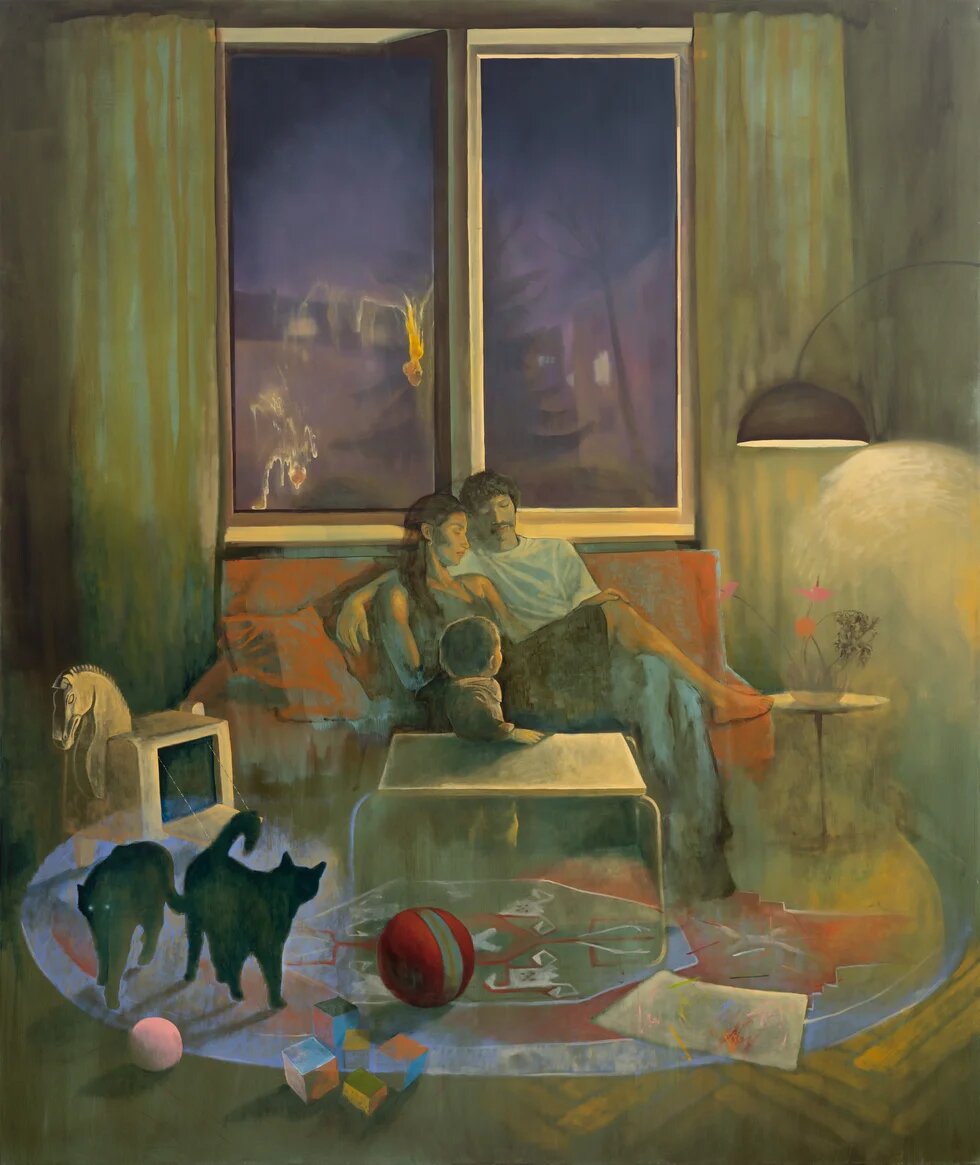
In the painting “View from the Window,” three people are visible: a woman, a man, and a child. There is something very intimate about the scene, which in turn stands in stark contrast to the marks left by an egg thrown on the window. The traces of this everyday microaggression draw the viewer’s attention and disrupt the warm atmosphere.
The installation “Midnight in the Neighborhood” depicts a flight of stairs. It is an impressive metal sculpture illuminated by numerous lights. The entire space is filled with enormous shadows that seem to take on a life of their own. The stairs allude to a memory from the artist’s childhood. The neighborhood where he lived at the time was attacked by a group of skinheads. Together with other children, he hid on the top floor of one of the houses. The staircase has since become a symbol of the trauma and fear that still resurface whenever he recalls those events.
The exhibition’s curator, Monika Weychert, aware of the role art plays in contemporary society, has for many years consistently sought to increase the visibility of Romani artists in the art world. The exhibition “Nobody Wants You Here” became a manifestation of her efforts. Her doctoral dissertation, titled “The Invisible Genocide: Contemporary Romani Art as a Rebellion of the Subjugated Others,” received distinction from the Rector of SWPS University. She has been collaborating with TVP Kultura for many years; she is the author of articles published in academic and critical journals as well as in exhibition catalogs. She is a book editor, a member of AICA, and an assistant professor and coordinator of the journalism and social communication program at SWPS University. To better understand the essence of the exhibition and the underlying issues related to exclusion and polarization in today’s society, we asked the curator a few questions.
As a curator, why did you decide to address this topic and organize this exhibition in collaboration with the artist – what influenced your decision to choose this theme?
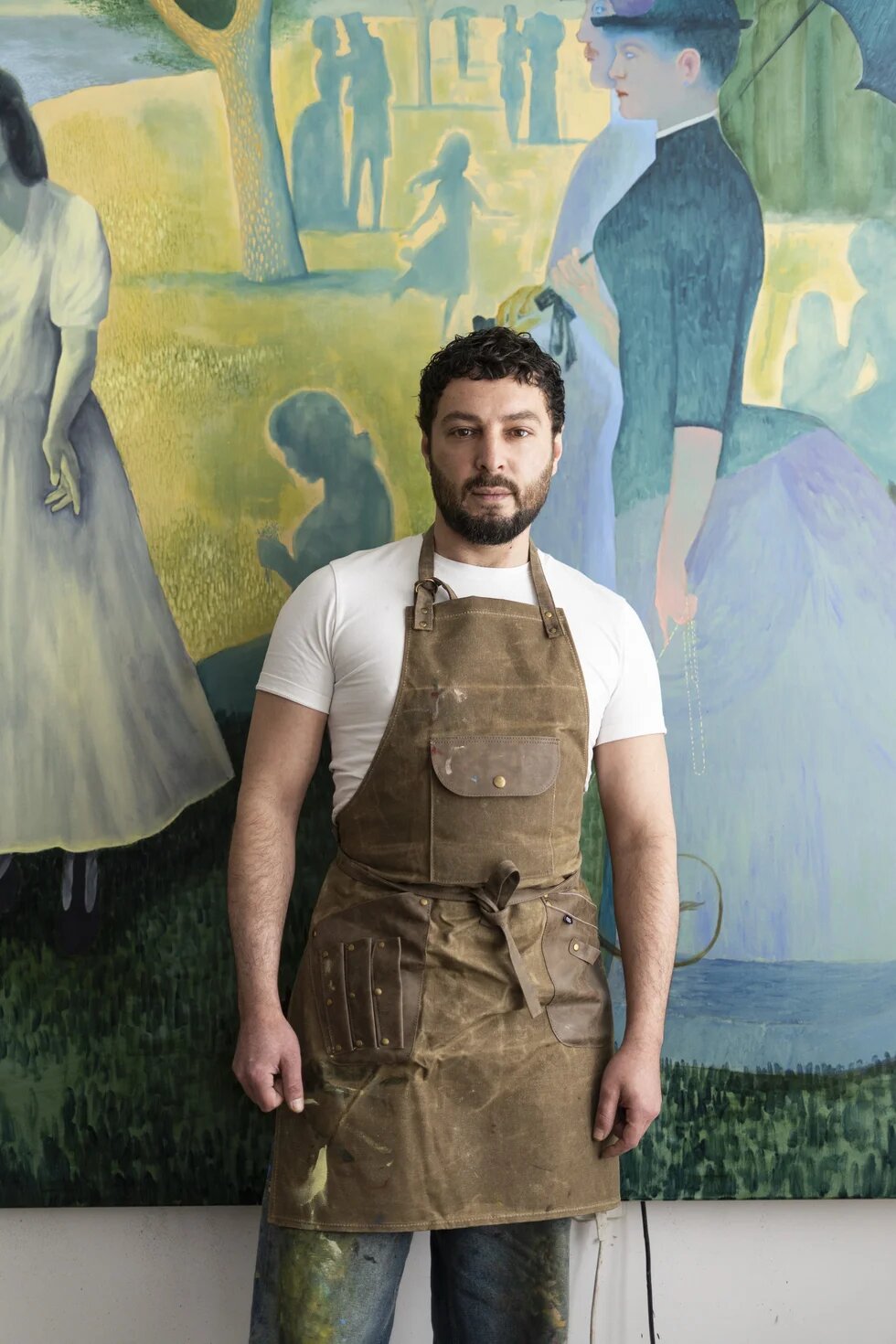
The idea to reflect on historical and contemporary mechanisms of ghettoization came from the artist – Krzysztof Gil. On the one hand, it was an afterimage of his personal childhood memories, and on the other, an expression of the need to examine the current political situation in the world. I simply wanted to work with this artist because I knew that no matter what topic we tackled, the exhibition would be great. Krzysztof is incredible: he combines deep reflection and meticulous research with extraordinary technical skill. Everything comes together perfectly in his work.
The exhibition was conceived as a space for discussion about exclusion – both in a social context and in the relationship between art, artists, and society. From a curator’s perspective, were you able to spark such a dialogue? During the exhibition, were there any reactions or conversations with visitors that particularly moved or surprised you?
It was an interesting experience. One of the rooms was filled with plastic chairs throughout the exhibition. This and similar models have a long history. In 1946, Douglas C. Simpson created an innovative design, and its name – Monobloc – referred to the then-revolutionary fact that the chair was molded from a single piece of plastic. Low production costs and the ability to stack the chairs made them a simple way to provide seating for large numbers of people. Over time, its ubiquity became a point of contention. In Basel, for example, their use was banned on the grounds that detracted from the city's appearance. However, the use of both inexpensive and more expensive variations on the Monobloc and the Fauteuil 300 (Henry Massonet, 1972) currently brings people together across all continents and social classes. Despite the criticism and controversy surrounding the chair’s aesthetics and the environmental impact of its production, it serves as an example that truly universal design does not always have to be expensive or luxurious. Its strength lies in its simplicity and accessibility to everyone. I've gone on at length about the exhibition's architecture because this curatorial gesture worked wonders. No one hesitated to sit down in the exhibition space and spend more time there than they normally would. So, in this space as well, we offered accompanying events – discussions and workshops organized by the Towards Dialogue Foundation. We also held a series of guided tours and meetings with Krzysztof Gil and me. There were an incredible number of these conversations with visitors. I’ll say, somewhat provocatively, that some of the reactions didn’t surprise me at all. Not in the least. They stemmed from a mechanism I know very well: a lack of knowledge about the social history of Romani people in Europe. Once again, I saw just how much this new knowledge can surprise audiences. It seems to me that two phenomena are at play here. Using the tools of postcolonial criticism, but without a local context, simply isn’t enough to tell the stories of Polish citizens of Romani descent. One line of thought leads me here to a rather controversial book by Hans Kundnani. In a nutshell, the author argues that once Europe ceased to be a superpower in any sense – political, economic, or military – the only thing left to cling to in European identity is its civilizing mission. It is this mission that has become the foundation of the new European community as a civilizing power. In doing so, he refers to the concept proposed by József Böröcz, namely “Eurowhiteness” and “dirty whiteness” (for aspiring Central and Eastern European countries). Already in this instance, it is clear that there is no room in this framework for entities that are not quite white or for entities that are not white at all. The second pillar of the EU is the community of memory. As Kundnani writes: “But collective memory is always selective memory (…) Privileging the Holocaust, and insisting on its uniqueness, obscured its connections with colonialism and slavery (…)”. In this sense, Romani memory – the Genocide of the Roma – can be a competing force and contribute to undermining the EU’s myth-making narrative. This is why it has been pushed into oblivion for so long. It occupies an intermediate space between collective memory and forgetting: the realm of experiences that societies choose not to remember because forgetting them offers some form of social gratification. The second point, however, is much more practical, though equally important: “Contemporary Polish language lacks sufficient means to adequately describe the phenomena, processes, and problems of minority and non-dominant groups, which leads not only to these phenomena remaining invisible – because if something is not named or is inadequately named, it does not exist in the public consciousness – but also to the fact that these phenomena, processes, and problems remain misunderstood, and the meanings attributed to them are inadequate to what actually is,” as Margaret Ohia-Nowak – one of the guests on the program accompanying the exhibition – writes. What did surprise and move me were some of the personal associations visitors made with their own experiences. Pavel, from Brazil, had a different perspective on the Romani community and its social role, since as many as two presidents of that country had Romani ancestry: Juscelino Kubitschek, who openly acknowledged it, and Washington Luís Pereira de Sousa, whose Romani heritage has been more controversial and largely concealed. Tomasz from Poland spoke about his own experience of a transit camp as a ghetto when he emigrated from Poland in the 1980s. There were countless individual points of identification through which visitors interpreted the exhibition, many of them genuinely unexpected. Overall, the exhibition was exceptionally well-received by the public. This was also evident on social media, where migrants and people of color frequently shared their impressions – which is not all that common.
Today, more than ever, it is important to discuss the topics addressed in the exhibition. What role, in your opinion, can art play in a society experiencing polarization, prejudice, and mutual misunderstanding? As a curator, how do you view your role in creating spaces for such conversations?
If I’m to draw on my own experiences, I’m currently somewhat skeptical about art’s ability to directly influence society. My naive belief that this could be the case has simply vanished. If even one person changes their perspective on a given topic thanks to an encounter with art, I consider that a tremendous success. In this age of populism and fake news, art is competing with messages that are simple, persuasive, and highly effective. Can Krzysztof Gil’s sophisticated and metaphorical works serve as a communicative alternative to them? – I’m afraid not. However, I also believe that a drop can wear away a stone. And this is where I feel quite fulfilled as a curator. When I organized exhibitions featuring artists of Romani descent in 2013 and 2014, it was still surprising to many people in Poland. Today, we’ve already had the Polish Pavilion in Venice, where we were represented by Małgorzata Mirga-Tas – the first Romani woman in a national pavilion in the history of the Venice Biennale. Romani artists are exhibiting in the world’s art centers. Over the past ten years, the situation has changed dramatically. I believe that such processes take time.
What would you like visitors to take away from this exhibition? Is there a particular thought, question, or emotion you’d especially like to leave the audience with as they leave the gallery?
Above all, the messages that Krzysztof Gil conveys to us. First, that the stories he weaves through his narrative works concern Romani men and women as citizens of Poland, and that the Polish aspect of these individuals’ identities is of immense importance – they speak of the experience of shared citizenship. The second idea is the importance of offering self-representational testimony, but not through the reproduction of violence. It would be easy for such an outstanding painter to depict scenes of pogroms, which are among the events he addresses. However, by avoiding literal representation, Gil elevates these situations to a universal level. Any one of us today can be rejected for some reason. As Ece Temelkuran writes, we are all, in some way, dispossessed, and we can all, in some way, be perceived as outsiders. It is, therefore, necessary to reflect on the foundations upon which our new community can be built today. It is clear that it must change. Otherwise, we will move forward only with great difficulty, crossing the boundaries of one ghetto after another.
How do you envision the presence of works by Romani artists in Polish cultural institutions? What needs to change for them to become part of these institutions’ regular programming?
I envision the presence of artists with Romani roots in the institutional art world exactly the same as the presence of any other artist and any other creative work. As Terry Eagleton writes: “Like any radical movement, identity politics is internally contradictory: you are free when you no longer have to worry about who you actually are. In this sense, the end contradicts the means.” Not everyone feels comfortable serving as a spokesperson for their community. They may choose to do so, but they are under no obligation to. And so I envision them on an equal footing – just as I do people of other ethnic backgrounds living in Poland.
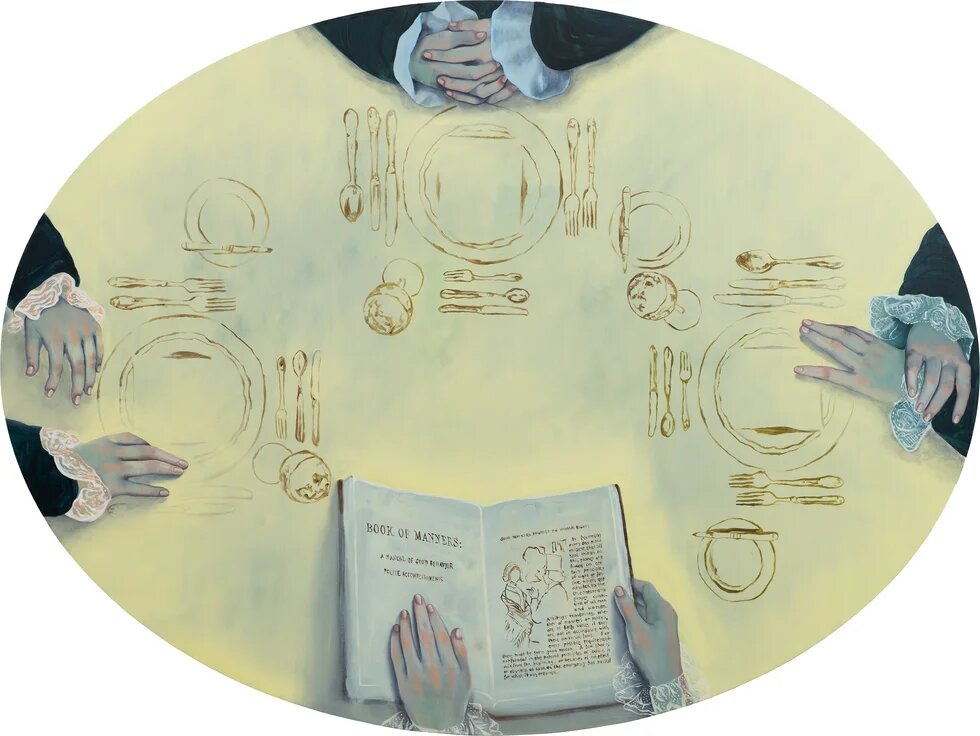
Art as a Space of Dialogue and Shared Understanding
In a society where political discourse is increasingly shaped by populist, radical, and media-friendly narratives, remaining consistently committed to one’s values becomes particularly important, despite the political center shifting to the right. As a result, views that were considered extreme not long ago are gradually gaining social legitimacy, while issues previously perceived as neutral are becoming politicized.
What role does art play in all of this? Art is part of civil society. No matter how small the impetus may be, it is precisely here that a discussion can be directed or initiated. It is art that enables citizens to understand, with their hearts, other ways of seeing the world without having to adopt a defensive stance. Art and the places where we encounter it can become a refuge, while political divisions dominate elsewhere. Art can provide us with inspiration and push us in directions we don’t even notice in everyday life or in political debates.
Krzysztof Gil’s exhibition offers a specific experience, allowing visitors to try, even if only to some extent, to imagine what it means to exist between two cultures Through the exhibition, visitors have the opportunity to experience the beauty of dual cultural belonging and the diversity it offers, but also – and especially – how society continues to exclude and discriminate against people of ethnic backgrounds different from the majority. The exhibition encourages dialogue. These works stir the heart to empathy. “Involvement is the only way to stay in touch with reality” said Heinrich Böll. And Gil’s works encourage precisely that: intervention. Especially today.
The views and conclusions contained in the text express the opinions of the exhibition curator and do not necessarily reflect the official position of the Heinrich Böll Foundation.